
If you’re thinking about selling your house to a cash buyer, you’re probably wondering one thing right away:
Do cash home buyers make lowball offers in El Paso?
Not all we buy houses companies make lowball offers—but some do, especially when sellers don’t fully understand how those numbers are calculated.
Legitimate cash buyers don’t just pick a number—they work backward from what the property could realistically sell for after improvements.
It’s a fair question—and the honest answer is: sometimes.
But what most homeowners don’t realize is that what feels like a low offer isn’t always unfair.
In this guide, we’ll break down how cash offers actually work, when they’re reasonable, and how to tell if you’re getting a fair deal or being taken advantage of.
Why Some Cash Offers Can Feel Lower Than Expected
Many homeowners expect a cash offer to match what they see online or what they believe their home is worth.
But cash buyers look at properties very differently than traditional buyers—and that’s where the disconnect happens.
A cash offer isn’t based on a “retail” price. It’s based on what the home is worth after repairs, costs, and risk are factored in.
For example, if a home needs updates, has deferred maintenance, or would take time to sell on the market, those factors directly impact the offer.
That’s why two homes with similar layouts can receive very different offers depending on condition and situation.
In many cases, what feels like a low offer is really a reflection of the true cost of getting the home market-ready and sold.
How Cash Buyers Actually Determine Their Offers
Not all we buy houses companies make lowball offers—but some do, especially when they’re relying on sellers not fully understanding the numbers.
Legitimate cash buyers don’t just pick a number—they work backward from what the property could realistically sell for after improvements.
This process typically starts with an estimated after-repair value, which is what the home might be worth once it’s updated and ready for the market.
From there, they factor in the cost of repairs, holding costs, closing costs, and the risk involved in taking on the project.
For example, even smaller issues like an aging roof, outdated systems, or cosmetic updates can quickly add up. In fact, many homeowners are surprised when they see what it really costs to sell a house as-is once repairs, time, and preparation are factored in. In many cases, sellers don’t realize how much these items can impact the final number.
This is why some homeowners feel like cash home buyers make lowball offers when the process isn’t clearly explained.
When a Cash Offer Might Actually Be Too Low
Not every cash offer is fair.
While many investors base their numbers on real costs and market conditions, there are also buyers who make extremely low offers hoping a seller doesn’t know any better.
Some common signs of a lowball offer include:
- The buyer gives you a number with little to no explanation
- They pressure you to accept quickly without giving you time to think
- The offer feels significantly lower than other options you’ve considered
- They avoid answering questions about how they came up with their price
A legitimate buyer should be able to walk you through how they reached their offer and give you space to make the decision that’s right for you.
If something feels off, it’s worth taking a step back and getting a second opinion before moving forward.
How to Tell If a Cash Buyer’s Offer Is Fair
The key isn’t just looking at the number—it’s understanding what that number represents.
A fair cash offer should take into account the condition of the home, the cost of repairs, the time it would take to sell traditionally, and the overall convenience of the sale.
One of the easiest ways to evaluate an offer is to compare what you would realistically walk away with in different scenarios.
For example, a higher offer on the market might require repairs, agent commissions, closing costs, and months of uncertainty. A cash offer may come in lower, but with fewer costs, no repairs, and a faster closing.
The difference often comes down to net outcome, not just price.
If you’re unsure, learning how to tell if you’re dealing with a serious buyer or just someone fishing for a deal can help you make a more confident decision.
What Most Sellers Don’t Realize About Higher Offers
Many homeowners assume the highest offer is always the best option—but that’s not always the case.
A traditional offer may come in higher on paper, but it often comes with additional costs, repairs, commissions, and the possibility of delays or cancellations.
In some situations, deals fall through after inspections or financing issues, which can put sellers back at square one.
On the other hand, a cash offer is typically more straightforward. There are fewer contingencies, no lender requirements, and the timeline is usually much shorter.
When you factor in the total cost, time, and uncertainty, the difference between a higher offer and a lower cash offer can be much smaller than it initially appears.
For homeowners in situations where speed, condition, or convenience matter, exploring options to sell your house fast can help you better understand what makes sense for your situation.
What Is Considered a Lowball Offer From a Cash Buyer?
A lowball offer in real estate is typically one that comes in significantly below market value without a clear explanation based on the property’s condition, costs, or comparable sales.
The problem is, most sellers don’t have a clear benchmark to compare against.
A Simple Way to Evaluate Whether a Cash Offer Is Fair
- Does it account for the home’s condition?
If the property needs significant repairs, a lower offer may be justified—but it should be backed by real estimates. - Is there a clear breakdown of costs?
A legitimate buyer should be able to explain how they arrived at the number, including repairs, holding costs, and risk. - Are you comparing it to what you would realistically walk away with after listing?
The true comparison isn’t just listing price—it’s what you would walk away with after repairs, commissions, and time on market.
When you look at it this way, a “low” offer isn’t always unfair—it just needs to be understood in the context of what you’d net in a traditional sale.
Real Seller Story: When Fairness Beat the Highest Offer
We worked with a homeowner who received multiple cash offers on their property. One buyer gave them a number with no explanation—just a quick offer and pressure to accept.
Another buyer walked them through everything: the estimated repairs, holding costs, and how the final number was calculated.
Even though the offers weren’t drastically different, the second one gave the seller confidence because it actually made sense.
That’s the difference between a number on paper and an offer you can actually understand.
How We Buy Casa Calculates Their Offers
At We Buy Casa, our goal isn’t just to give you a number—it’s to make sure you understand exactly how that number was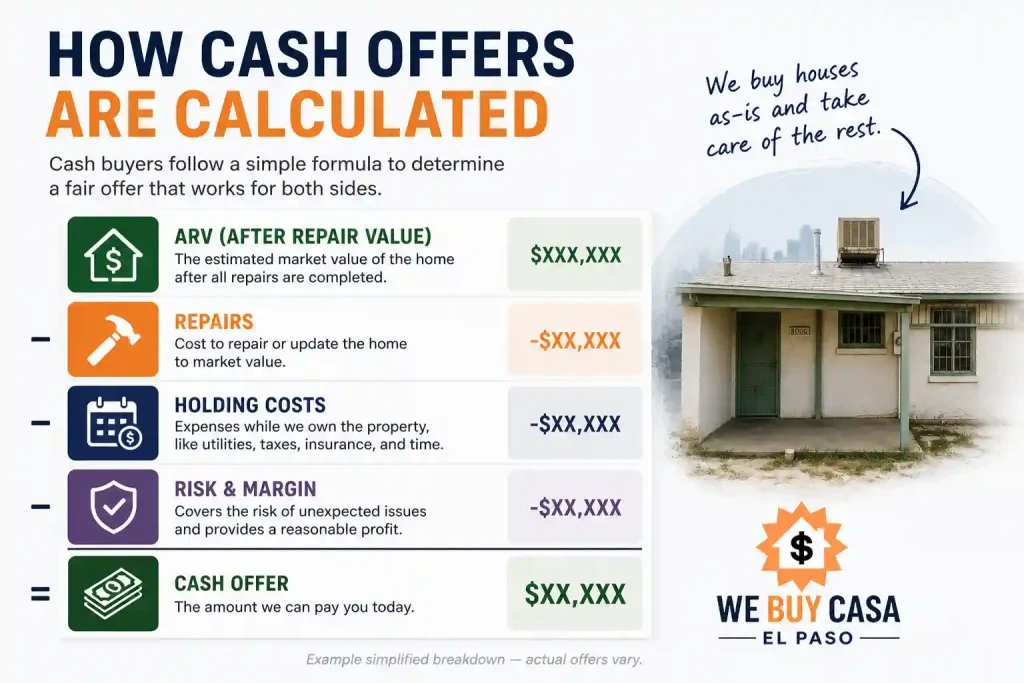 calculated.
While every property is different, we follow a consistent process that takes into account the real costs, risks, and timeline involved in the sale.
After Repair Value (ARV)
– Estimated Repairs
– Holding & Transaction Costs
– Risk & Margin
= Cash Offer
Every part of the offer should be explainable. If a buyer can’t clearly walk you through how they arrived at their number, that’s something to question.
It’s also why two buyers can look at the same property and come up with different offers—depending on how they estimate repairs, risk, and what they believe the home can realistically sell for.
The most important thing isn’t just the number—it’s whether the process behind it makes sense.
How to Choose a Reputable Cash Buyer
Not all cash buyers operate the same way, and choosing the right one can make a significant difference in both your experience and your outcome.
Taking a little time to evaluate who you’re working with can help you avoid unnecessary stress and make a more confident decision.
Here are a few ways to tell if you’re dealing with a reputable cash buyer: 
- They clearly explain how they arrived at their offer
A legitimate buyer should be able to walk you through their numbers, including estimated repairs, costs, and how they determined the final price. - There’s no pressure to make a quick decision
If someone is rushing you to sign or creating urgency, that’s usually a red flag rather than a benefit. - They have a track record you can verify
Look for real reviews, past transactions, or examples of properties they’ve purchased in your market. - They communicate clearly and consistently
You should feel informed throughout the process. Delays, vague answers, or poor communication can signal potential issues. - Their process is straightforward and transparent
You should understand what happens next, how long it will take, and what to expect at each step of the sale.
Taking the time to evaluate your options can make the difference between a smooth, confident sale and a frustrating experience.
Frequently Asked Questions About Cash Home Buyers
Do cash home buyers make lowball offers?
Cash home buyers can make lower offers than what you might see on the traditional market, but that doesn’t automatically mean they’re lowball offers. Most investors factor in repairs, holding costs, and risk when determining a price. The key is whether the offer makes sense based on your home’s condition and your situation.
How do I know if a cash offer is fair?
A fair cash offer should be based on the condition of your home, the cost of repairs, and what you would realistically walk away with after listing. Comparing your net outcome in both scenarios is often the best way to evaluate whether an offer makes sense.
Can I get multiple cash offers on my house?
Yes, you can—and it’s often a good idea. Different buyers may evaluate your property differently, which can lead to variations in both price and terms. Comparing multiple offers can give you a clearer picture of what’s reasonable.
Is selling to a cash buyer a good idea?
This is why many homeowners choose toIt depends on your situation. For homeowners who want to avoid repairs, sell quickly, or reduce uncertainty, working with a cash buyer can be a practical option. For others, listing on the market may make more sense. sell their house as-is instead of investing time and money into repairs before listing.
How fast can a cash home sale close?
Some cash sales can close in as little as 7 to 14 days, depending on the buyer and title process. This is typically much faster than a traditional sale, which can take several weeks or longer.
Final Thoughts
Selling your home is a big decision, and it’s natural to question whether a cash offer is truly fair.
While some offers may come in lower than expected, the real focus should be on what makes the most sense for your situation. Factors like the condition of the property, the time it would take to sell, and the level of certainty you need all play a role in determining the right path forward.
The most important thing is understanding your options, asking the right questions, and working with someone who is transparent about the process.
When you take the time to look at the full picture—not just the price—you’ll be in a much better position to make a decision you feel confident about.
What to Do Next
If you’re trying to figure out the best path forward, the right choice usually comes down to your timeline, the condition of your home, and how much certainty you want in the process.
Some homeowners decide to list, others explore selling on their own, and many choose a simpler route when speed or convenience matters more.
If you want to understand what a direct sale actually looks like from start to finish, you can learn more about how the process works and see what makes sense for your situation.
